News Story
Object Detection in Cislunar Space: Nguyen Awarded DARPA Grant

Tam Nguyen, assistant professor at the University of Maryland’s (UMD) Department of Aerospace Engineering, has been selected by the Defense Advanced Research Projects Agency (DARPA) to lead a new, $2 million endeavor aimed at enabling improved detection and tracking of objects in cislunar space.
She’ll be collaborating with Advanced Space, a Colorado-based firm with a focus on sustainable space exploration, to develop a high-tech approach that will allow users to “see everything, everywhere, at once,” in cislunar space, as she puts it, and at a lower cost than would be possible with conventional sensing approaches.
“Cislunar space” refers to the three-dimensional area between the Earth and the Moon—an expanse totaling more than 200,000 miles in radius. DARPA’s goal is to enable continuous space-based detection and tracking of objects in this region, thus increasing the safety of cislunar commercial and civilian traffic, and contributing to the peaceful use of space for the benefit of all.
Keeping tabs on cislunar space isn’t easy, Nguyen notes. “There are a lot of objects in different orbits, but we don’t currently have an efficient way to track them. There’s no single system that can see the entire volume,” she said.
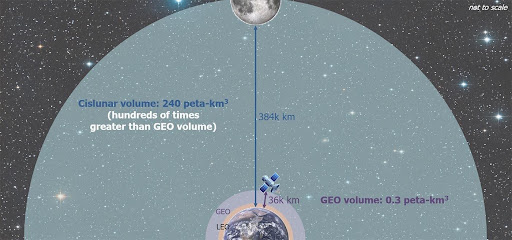
A graphic depicts the vastness of cislunar space, which contains hundreds of times the volume of the space in geosynchronous orbit. [Source: DARPA]
To address the challenge, Nguyen and her team are taking advantage of developments in highly efficient search and detection algorithms paired with commercial-off-the-shelf optics. The idea is to place a space telescope at a specific location that is far enough away from the cislunar zone to view it in its entirety. That location, known as the Sun-Earth L1 point, is 930,000 miles from Earth and 683,000 miles from the Moon. Nguyen and her team of graduate students and post-docs will be coming up with the design for this mission.
Though the view from L1 will be panoramic, the objects in that view will be tiny and dim—and that’s where optical and algorithmic wizardry comes in.
“Because it's so far away, everything is going to be so dim,” Nguyen said. “And that's why we need the processing component. We have a track-before-detect algorithm that is very efficient in detecting very faint, moving objects.”
The need for a cost-effective, reliable solution, like the one being developed by Nguyen and Advanced Space, has become increasingly critical as commercial and other activity burgeons in the corridor between Earth and Moon.
“There’s been a pretty significant ramp-up in space activities,” Nguyen said. “Everyone’s launching satellites, including commercial companies as well as space agencies, and there are a lot of things out there. Collision risks are increasing. Things are getting lost. The solution we’re developing will help ensure a sustainable ecosystem in this region of space.”
It will also strengthen planetary defense by improving the detection and tracking of near-Earth asteroids and potentially hazardous asteroids as they approach the Earth-Moon system, she said.
A UMD aerospace engineering faculty member since Fall 2024, Nguyen came to the department from the Massachusetts Institute of Technology’s Lincoln Laboratory, where she led programs in advanced sensing capabilities, space-based instrumentation, and space mission architectures. She is the recipient of a DARPA Young Faculty Award, given in 2025.
Advanced Space, which will be handling the flight software development and systems engineering for the project, has led or contributed to several milestones in space exploration since it was founded in 2011. In 2022, it became the first commercial company to operate a privately owned and operated spacecraft in orbit at the Moon for NASA, called CAPSTONE (Cislunar Autonomous Positioning System Technology Operations and Navigation Experiment).
“We’re proud to partner with Professor Tam Nguyen and the University of Maryland on this important DARPA effort,” said Bradley Cheetham, President & CEO of Advanced Space. “As activity in cislunar space continues to grow, improving our ability to detect and track objects across this vast region will be essential for safety, sustainability, and future mission success. Advanced Space is excited to contribute our flight software and systems engineering expertise to enable a new generation of space situational awareness capabilities.”
Published October 6, 2026
Recent Stories
Stories / Oct 21, 2026
Flatau Receives ASME SMASIS Dedicated Service Award

Stories / Oct 6, 2026
Object Detection in Cislunar Space: Nguyen Awarded DARPA Grant

Stories / Oct 5, 2026
Celebrating LGBTQ+ History Month 2026

Stories / Sep 28, 2026
Searching for ET—One Particle at a Time

Stories / Sep 22, 2026
Aerospace Department Welcomes Assistant Professor Harsh Bhundiya

Stories / Sep 22, 2026
Two Years Running, Maryland #12 Among Publics for Undergrad...

Stories / Sep 18, 2026
Congratulations to Aerospace Engineering’s Class of ’26...

Stories / Sep 3, 2026
Professor Derek Paley Named ASME Fellow

Stories / Aug 25, 2026
Minta Martin Professor Norman Wereley Named SAMPE Fellow

Stories / Aug 19, 2026
Maryland Applied Graduate Engineering Announces New Online...
