News Story
Basak Wins VFS Award for Autonomy Research

The quadrotor autonomously landing on the simulated ship deck
Kumardip Basak, a doctoral student at the University of Maryland (UMD) Department of Aerospace Engineering, has received the Best Paper Award in Autonomy & UAS from the Vertical Flight Society (VFS).
Basak earned the award for his paper “Vision-based Quadrotor Landing Tests on a Large Stochastic Platform Under Degraded Visibility,” which was presented at the VFS Annual Forum 82 in May. His co-authors are professors Anubhav Datta and Inderjit Chopra, who serve respectively as associate director and director of the Alfred Gessow Rotorcraft Center (AGRC).
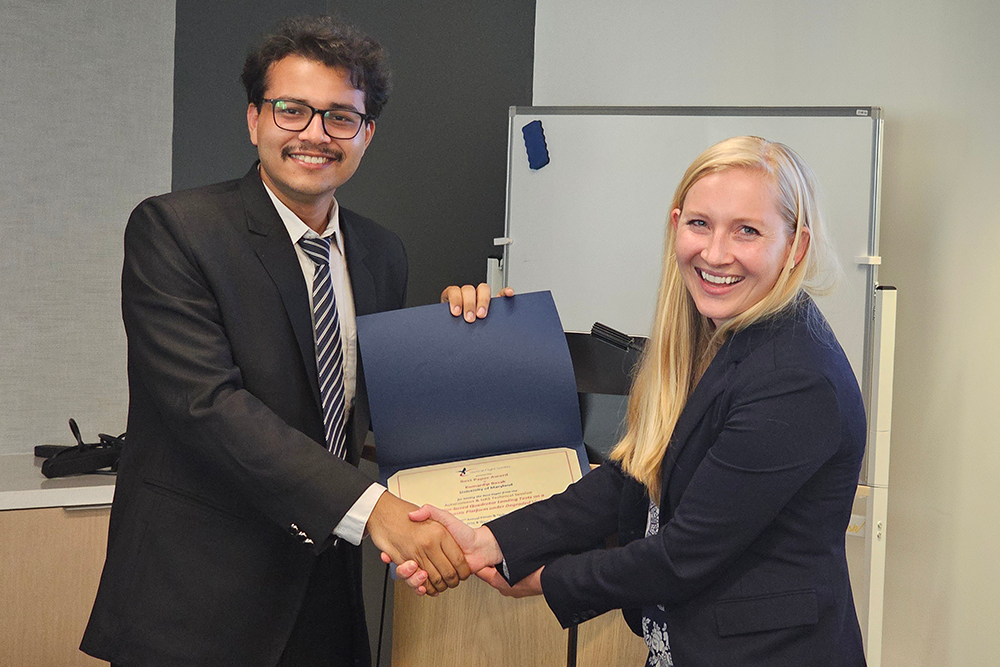
Basak (left) was officially presented with the award by VFS Federal City Chapter President Lauren Wolfe.
The paper sets out to address challenges associated with the autonomous landing of vertical-lift aircraft on ship decks without heavy and expensive ship-based support or on-board GPS or LiDAR. Such landings present a serious challenge because of their unpredictability, stochastically moving decks, stormy seas, buffeting winds, and degraded visibility conditions like occlusion, water distortion, and glare.
Basak has developed and demonstrated a new and innovative feature-based autonomous landing system, employing a vision algorithm, that can help vertical lift aircraft land more reliably in such conditions. In addition to detailing the system, his paper presents the results of tests conducted with a custom-built quadrotor utilizing a single monocular camera, on a six-degree-of-freedom, 1.5-ton Stewart platform, reproducing the stochastic motions typically experienced by DDG-51-class warships, which form a core part of the U.S. Navy fleet.
His experiments began with nominal conditions, followed by a stepwise degradation of deck features through occlusion, low illumination, water distortion, and glare. The vision algorithm tracked the platform and achieved landing across all scenarios, with tracking errors of up to 14% of the vehicle footprint and up to 2.2◦ of pitch and roll.
“The future of aviation will rely on advanced autonomous technologies that enhance safety and situational awareness in challenging environments, including degraded visibility and operations on moving ship decks. Kumardip's work combines innovative autonomous landing algorithms with rigorous experimental validation, representing an important step toward safer, more capable, and more resilient rotorcraft. This is an outstanding contribution to the future of vertical flight technology.”, said Tomasz Krysinski, former VP of Airbus Helicopters and a distinguished Visiting Professor at Maryland.
Basak is a third-year Ph.D. student in the department, with Datta as his advisor. He is also a graduate research assistant at the AGRC, one of three rotorcraft centers of excellence established at U.S. universities by the Army, Navy, and NASA.
Published August 18, 2026
Recent Stories
Stories / Oct 6, 2026
Object Detection in Cislunar Space: Nguyen Awarded DARPA Grant

Stories / Oct 5, 2026
Celebrating LGBTQ+ History Month 2026

Stories / Sep 28, 2026
Searching for ET—One Particle at a Time

Stories / Sep 22, 2026
Aerospace Department Welcomes Assistant Professor Harsh Bhundiya

Stories / Sep 22, 2026
Two Years Running, Maryland #12 Among Publics for Undergrad...

Stories / Sep 18, 2026
Congratulations to Aerospace Engineering’s Class of ’26...

Stories / Sep 3, 2026
Professor Derek Paley Named ASME Fellow

Stories / Aug 25, 2026
Minta Martin Professor Norman Wereley Named SAMPE Fellow

Stories / Aug 19, 2026
Maryland Applied Graduate Engineering Announces New Online...

Stories / Aug 18, 2026
Basak Wins VFS Award for Autonomy Research
